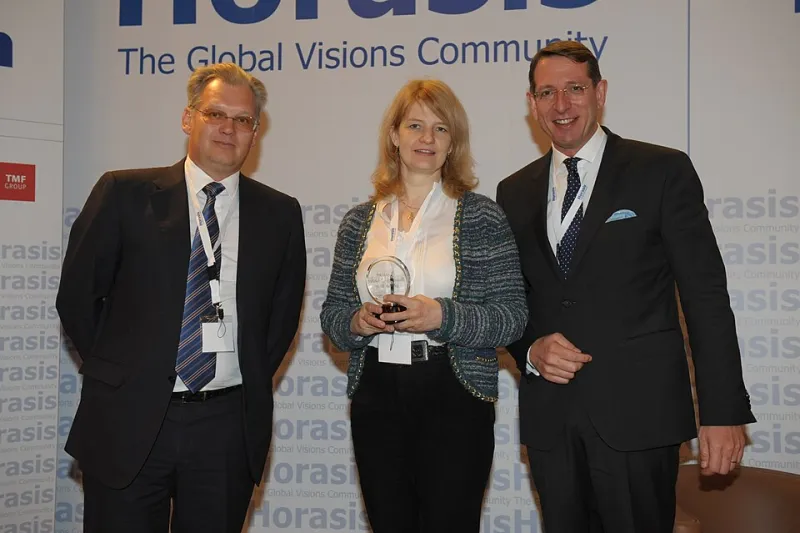
When the Trophy Comes Home: How International Acclaim Forces a Reckoning with Domestic Reality

Photo: Unknown authorUnknown author, CC0, via Wikimedia Commons
There is a particular kind of corporate discomfort that arrives not with failure, but with success. A company earns global recognition—perhaps for breakthrough sustainability practices, a transformative workplace culture, or category-defining innovation—and the congratulations flow in from every continent. Then an employee in the company's Ohio distribution center reads the press release and sends a quiet message to HR: We don't operate anything like this here.
That moment, replicated across industries and organizational sizes, defines what observers in the international recognition space have begun calling the Global Awards Paradox. It is the phenomenon in which winning on the world stage simultaneously illuminates excellence and exposes inconsistency—and it is reshaping how thoughtful American business leaders approach both recognition and reform.
The Mirror That Awards Hold Up
Global award programs do not simply validate. At their most rigorous, they audit. Programs recognized across the international business community typically evaluate entrants against criteria that are both aspirational and measurable: carbon reduction commitments tied to verified data, employee engagement scores compared against sector benchmarks, innovation pipelines assessed for commercial viability. When a U.S. company clears those bars, it earns a credential. It also inherits a standard.
The problem arises when that standard applies only to the division, initiative, or geography that was submitted for evaluation. A technology firm's European headquarters might have pioneered a four-day workweek model compelling enough to win a global workplace excellence award, while its American counterpart operates on a traditional schedule with below-average retention rates. A consumer goods company might win international recognition for its supply chain transparency in Southeast Asia while its domestic sourcing practices remain largely opaque.
In each case, the award is legitimate. The recognition is earned. And yet the gap between what was recognized and what is practiced company-wide creates a vulnerability that stakeholders—employees, investors, journalists, and regulators—are increasingly equipped to identify.
Cognitive Dissonance as Competitive Intelligence
The leaders who navigate this paradox most effectively are those who resist the instinct to manage the narrative and instead interrogate the gap itself. Rather than treating the inconsistency as a communications problem, they treat it as a diagnostic.
Consider the logic: if a company's international division demonstrated the organizational capability to achieve something award-worthy, that capability exists within the enterprise. The question is not whether the organization can operate at that standard—it already has. The question is why it has not done so uniformly, and what structural, cultural, or resource barriers are preventing replication.
This reframing transforms the paradox from a liability into a roadmap. The award, in effect, becomes internal proof of concept. Leaders who have successfully leveraged this dynamic describe a common approach: they use the external validation to build the internal business case. When a global recognition program certifies that a specific practice is both achievable and excellent, it becomes significantly harder for domestic stakeholders to argue that the same standard is impractical or cost-prohibitive.
The Scrutiny That Follows the Spotlight
Not every organization responds with that level of strategic clarity, and the consequences of inaction are increasingly visible. In an era when workforce transparency tools, ESG disclosure requirements, and social media accountability cycles operate at unprecedented speed, the gap between a company's award-winning narrative and its operational reality rarely stays private for long.
Employees who work in divisions that don't reflect the company's internationally recognized standards are among the first to notice—and, increasingly, among the first to speak. Glassdoor reviews, LinkedIn commentary, and internal employee survey data have a way of surfacing in newsrooms and investor briefings. When they do, the award that was meant to signal excellence can begin to function as evidence of selective excellence—which, in the eyes of many stakeholders, is a more damaging charge than no excellence at all.
Regulatory environments are compounding this pressure. As mandatory ESG reporting frameworks expand their reach in U.S. markets, companies that have claimed global recognition for sustainability or governance practices face heightened scrutiny when their domestic disclosures tell a different story. The award is not the problem; the inconsistency it reveals is.
From Recognition to Reinvention: What the Best Leaders Do Differently
Organizations that turn international recognition into genuine systemic change tend to share a set of deliberate leadership behaviors that are worth examining closely.
They extend the evaluation, not just the celebration. When a global award is won, high-performing leaders commission an internal gap analysis that maps the award criteria against every major domestic operation. The goal is not to find failures, but to identify the distance between current state and recognized standard—and to build a transition plan with accountability attached.
They make the award a public commitment, not just a credential. Rather than quietly displaying the recognition on a website and moving on, forward-thinking executives use the award announcement as an opportunity to articulate what achieving that standard company-wide will require. This approach invites accountability rather than avoiding it, and it signals to employees and investors alike that leadership views the recognition as a beginning, not an endpoint.
They appoint internal champions with cross-divisional authority. The practices recognized by global award programs rarely transfer themselves. They require advocates with the organizational standing to navigate budget cycles, regional resistance, and legacy systems. Companies that treat global recognition as a change mandate rather than a marketing asset tend to invest in the internal architecture needed to move that mandate forward.
They measure the delta over time. Perhaps most importantly, the best leaders track progress against the standard that earned them recognition in the first place. Annual internal reviews tied to the award's original criteria create a feedback loop that keeps the aspiration operational rather than ornamental.
The Broader Implication for American Business Leadership
The Global Awards Paradox is, at its core, a leadership integrity test. It asks whether a company's commitment to excellence is genuine or situational—whether it applies when judges are watching or when they are not. For U.S. companies competing on an international stage while managing complex domestic operations, that test is becoming harder to avoid.
The organizations that emerge strongest from this reckoning are those whose leaders understand a fundamental truth about global recognition: the award does not belong to the division that won it. It belongs to the enterprise that must now live up to it. Embracing that responsibility—rather than retreating from it—is the difference between a trophy on a shelf and a transformation in progress.
In the global recognition landscape, the most meaningful moment is rarely the night of the ceremony. It is the Monday morning meeting, back home, when someone asks what the award actually changes. The leaders worth watching are the ones who already have an answer.